A mature cashew tree typically produces somewhere between 7 and 14 kg of raw cashew nuts per year, depending on its age, variety, management, and where it's growing. That translates roughly to a few hundred individual nuts on the low end and well over a thousand on the high end. But getting to that range takes patience: most trees don't hit full stride until they're 8 to 10 years old, and plenty of trees never reach their potential because of avoidable problems with disease, nutrition, or poor-fit growing conditions. Here's what actually drives that number, and how to figure out where your own tree falls.
How Many Cashews Grow on a Tree Realistic Yield Ranges
Marcus Hendricks
24 Mar 2026
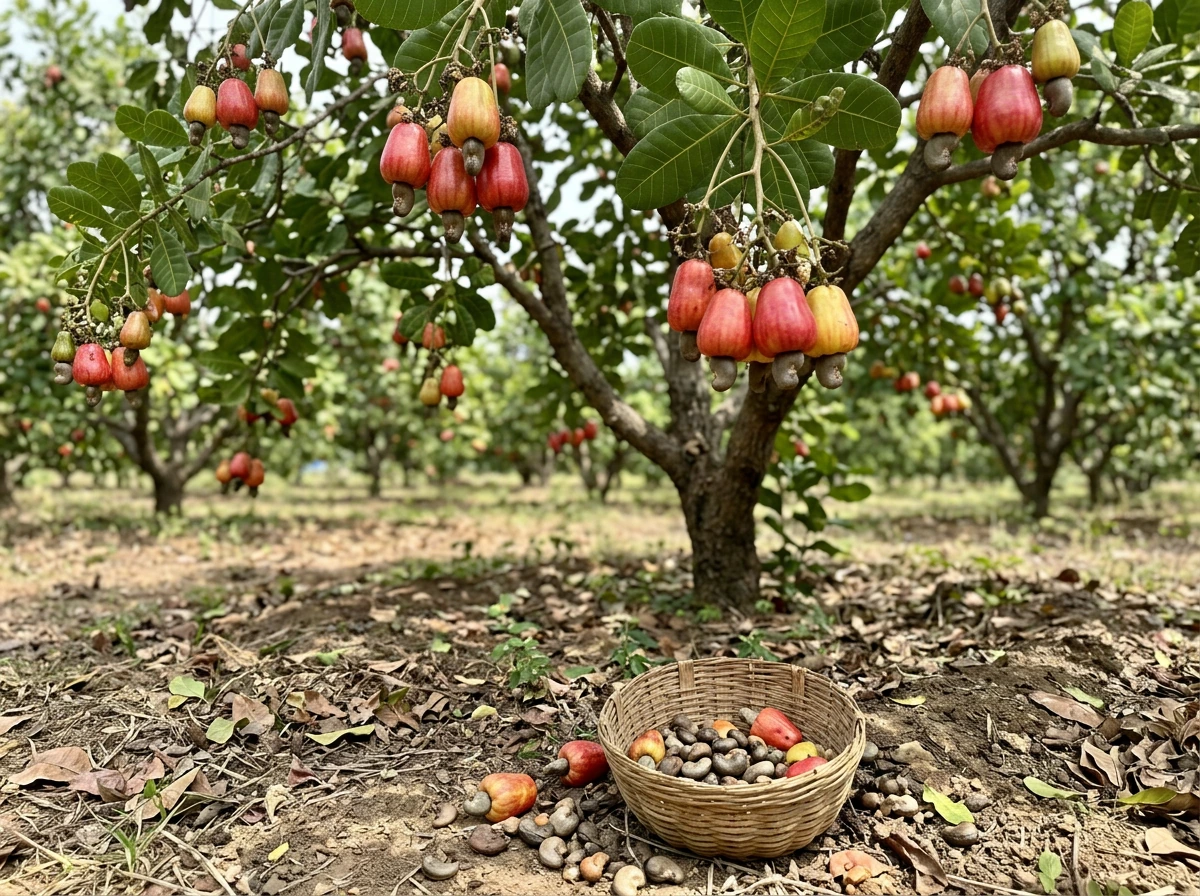
First, let's be clear about what "cashews" means on the tree
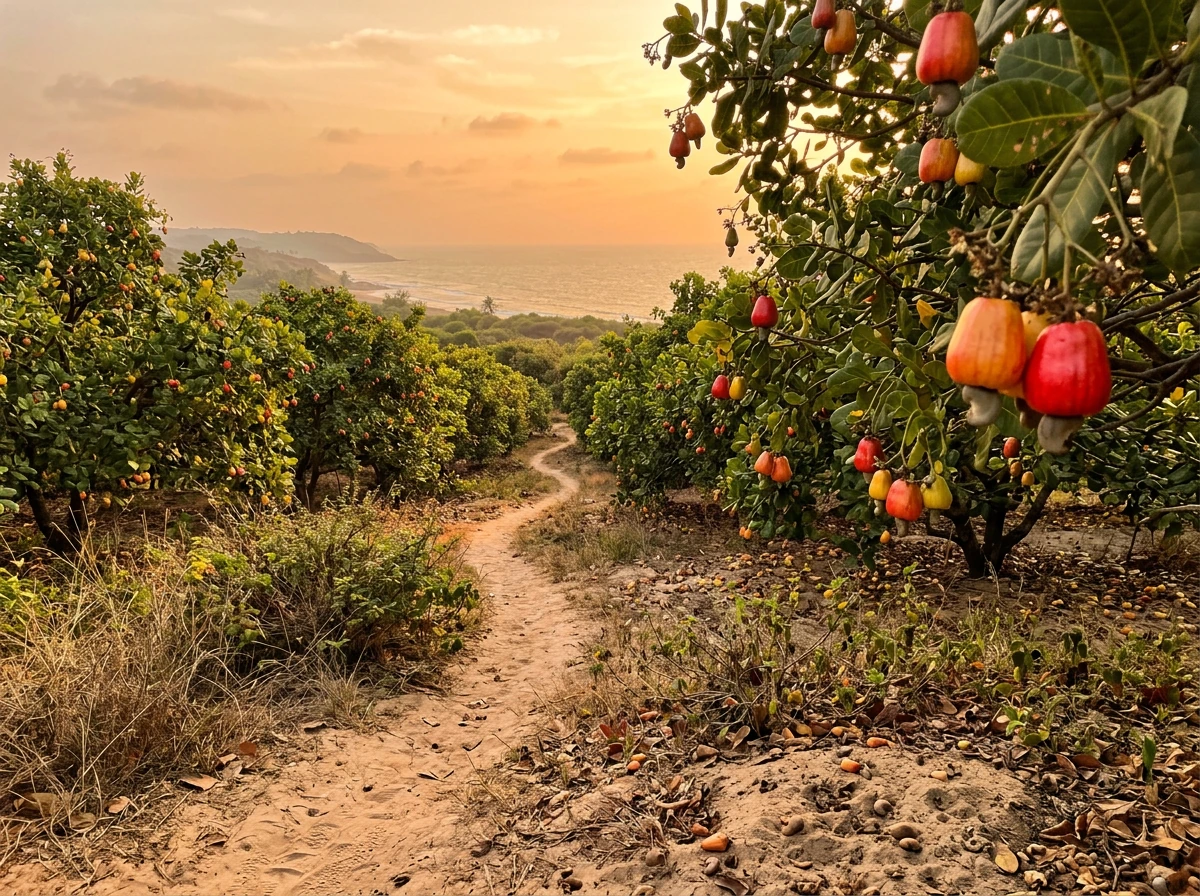
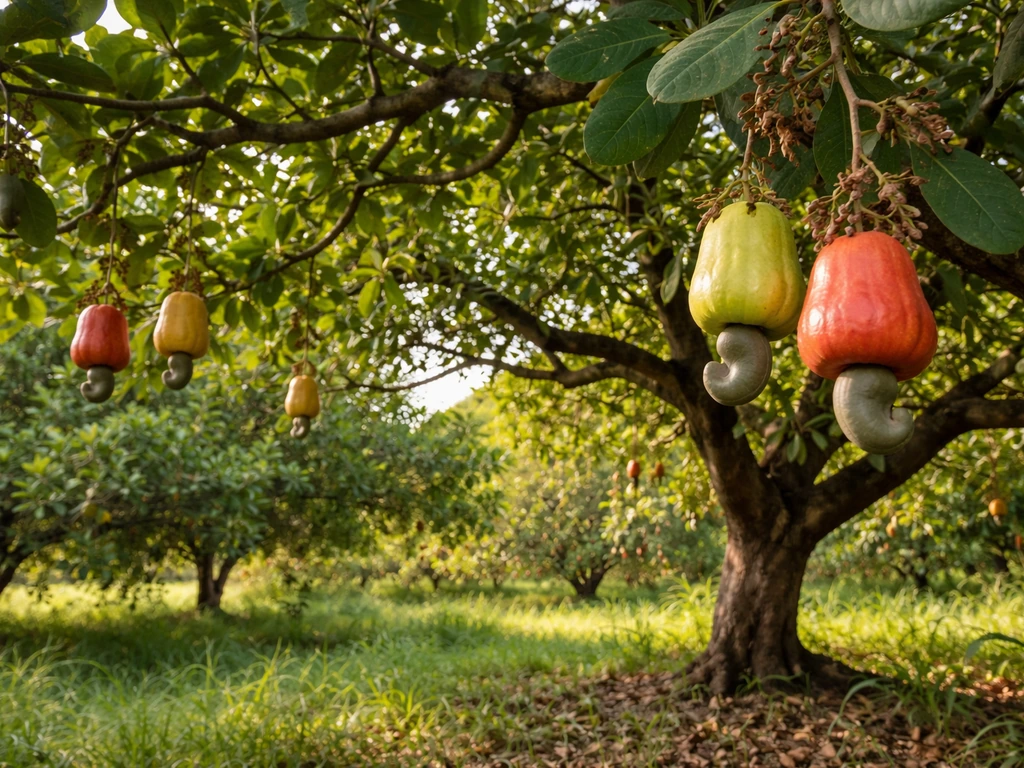
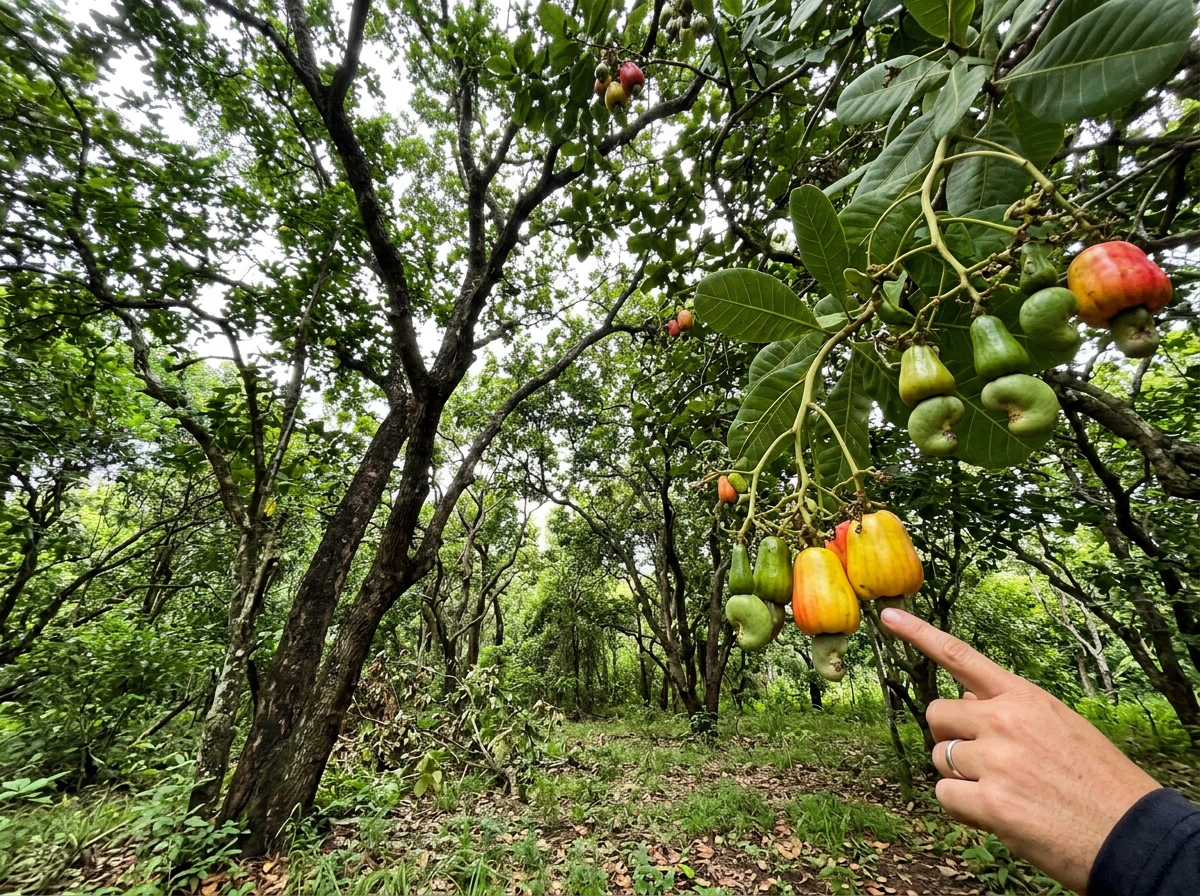
Every single cashew "nut" grows attached to the bottom of a swollen, fleshy structure called the cashew apple. The apple is actually an accessory fruit, an enlarged stem that turns red or yellow and looks like a small bell pepper when ripe. The true fruit is the kidney-shaped drupe dangling beneath it, and the edible cashew kernel is the seed inside that drupe's shell. So when you ask do cashews grow on apples, you're asking how many of those drupes reach maturity, because each one contains exactly one kernel. There's no bunch of nuts inside a single pod like with peanuts, and no cluster of seeds in one fruit like with almonds. It's strictly one nut per cashew apple, every time.
This matters practically because the cashew apple and the nut are both counted together when most yield figures are quoted in pounds or kilograms. UF/IFAS, for example, reports that a mature tree can produce around 50 to 75 lb of fruit, but that figure includes the apple, which is heavy and water-rich. The raw nut yield, what most growers actually track, is a much smaller fraction of that combined weight. If you see yield numbers without clarification, always check whether they mean cashew apple plus nut (combined fresh weight) or just the raw nut-in-shell.
What a realistic yield actually looks like
Here's the honest range you should plan around. Under typical field conditions without intensive management, FAO data from Sri Lanka puts average yield at around 4 to 5 kg of raw nuts per tree per year. That's not bad, but it's also well below what a well-managed tree can do. The same FAO source puts the potential yield at 10 to 14 kg per tree with proper practices in place. Coulter's widely cited monograph puts mature tree yields at 7 to 11 kg as a general average. Well-managed commercial plantations often land between those two figures.
At the plantation scale, that works out to roughly 0.5 to 2 tons of raw cashew nuts per hectare per year. The spread is huge because tree spacing, variety selection, and management intensity vary so dramatically between operations. A smallholder with unselected seedlings and minimal inputs sits near the bottom of that range. A commercial grower using improved cultivars, targeted fertilization, and disease control sits near the top.
| Scenario | Approximate yield per tree per year | Notes |
|---|---|---|
| Average under minimal management | 4–5 kg raw nuts | FAO Sri Lanka data; unimproved varieties, no intensive inputs |
| Typical mature tree, moderate management | 7–11 kg raw nuts | Coulter (1982) general range for mature trees |
| Potential with improved varieties and good practices | 10–14 kg raw nuts | FAO potential yield; recommended cultivars, disease control, proper nutrition |
| Combined cashew apple + nut (fresh weight) | 50–75 lb (~23–34 kg) | UF/IFAS figure; includes heavy apple flesh, not just the nut |
How age, variety, and farm practices shift your yield
Tree age matters more than almost anything else
Cashew trees typically start bearing fruit in their third or fourth year, but don't expect much from those early harvests. The yields are low and inconsistent while the tree is still establishing its canopy and root system. Full bearing age, when the tree reaches its production potential, is generally around the tenth year. Data from the Cashew Technology Handbook tracking variety AC4 shows yields climbing steadily through years 4 to 15, with the significant jump happening in the 8 to 10 year window. If your tree is younger than that and producing less than you hoped, that's almost certainly normal. Give it time before drawing conclusions about the tree's long-term performance.
Variety makes a surprisingly large difference
Not all cashew trees are created equal. Trees grown from unselected seedlings, which is still how a lot of smallholder orchards are established, tend to produce significantly less than trees grown from improved cultivars selected for high nut yield, disease resistance, and reliable fruit set. The Cashew Handbook 2008 puts the yield potential of recommended varieties at over 8 kg per tree, realizable after 8 to 10 years. Frontiers research on Guinea-Bissau production systems specifically attributes low plantation productivity partly to reliance on non-selected varieties. If you're planning a new planting and yield matters to you, sourcing grafted trees from a proven cultivar is one of the highest-leverage decisions you can make upfront.
Management practices: nutrition, pruning, and disease control
Yield responds noticeably to what you put in. Foliar nutrient applications, particularly balanced NPK sprays timed around the flowering period, have shown measurable yield increases in cashew trials. TNAU research involving foliar sprays of 1% NPK 19:19:19 at key growth stages reported yield gains of up to around 42% in some treatments. That's not a small number, and it points to nutrition as a real lever, not just a nice-to-have. Disease management is equally important: inflorescence blight, anthracnose, gummosis, and twig dieback are all documented yield limiters. UF/IFAS recommends protective fungicide applications (sulfur combined with a copper-based product) starting when flower panicles are half developed, with a follow-up 10 to 21 days later, specifically to improve fruit set success. Skipping this step during a wet flowering season can noticeably cut your nut count.
Climate and region: where cashew trees actually fruit well
Cashew trees are tropical plants with a fairly wide climatic tolerance. They grow from sea level up to about 1,000 m altitude and handle annual rainfall anywhere from about 400 to 4,000 mm, making them one of the more adaptable tropical tree crops. But "can survive" and "fruits well" are two different things. The trees are drought tolerant during dry periods, which actually helps them: cashews need a distinct dry season to trigger flowering. Without a reliable dry spell, flowering can be erratic and nut set poor. do cashews take a lot of water to grow do cashews take a lot of water to grow
The major producing regions, India, Vietnam, Côte d'Ivoire, Guinea-Bissau, Tanzania, Benin, and Brazil, all share a climate pattern with a pronounced dry season followed by rains. That seasonal contrast is what consistently pushes cashew trees into their flowering and fruiting cycle. If you're growing in a region without that seasonal rhythm, or where rainfall during the flowering period is excessive, expect lower nut counts and more disease pressure on the panicles. Wet conditions during flowering are one of the most reliable ways to reduce fruit set, because they both interfere mechanically with pollination and promote fungal diseases that kill flower panicles before nuts can form.
In the continental United States, cashew is really only viable in the warmest parts of South Florida, USDA Zone 11 and the warmest pockets of Zone 10b. Anywhere that sees frost, even light frost, will damage or kill a cashew tree. If you're in a marginal zone and wondering whether your region is suitable at all, that's worth exploring in detail alongside other tropical nut crops and their regional fit.
How to estimate how many nuts your own tree will produce
You don't need a laboratory to get a working estimate of your tree's seasonal yield. The math starts at the panicle level. Each cashew flower panicle (the branched flower cluster that forms at the tips of branches) contains many small flowers, a mix of male flowers and hermaphrodite (bisexual) flowers. Only the bisexual flowers can set fruit, and even then, roughly 70% of those fail to mature into a cashew apple and nut. Research consistently puts the result at somewhere between 1 and 6 mature nuts per panicle, with many sources citing 1 to 2 as typical for most inflorescences under field conditions.
Here's a practical way to build your own estimate during flowering season:
- Count the number of active panicles on your tree during peak flowering. On a mature tree this can be anywhere from a few dozen to several hundred depending on canopy size and health.
- Assume conservatively that each panicle will produce 1 to 2 mature nuts. Use the higher end (up to 4 to 6) only if conditions are dry, disease pressure is low, and the tree is well-nourished.
- Multiply your panicle count by your per-panicle estimate. That gives you a rough nut count for the season.
- As fruit set progresses over the following weeks, count the actual developing cashew apples on a sample of branches and scale up to the whole tree to refine your estimate.
- Weigh a handful of raw nuts at harvest to establish an average weight per nut, then multiply by your count to estimate total weight.
This approach won't give you a number accurate to the kilogram, but it will tell you quickly whether your tree is setting fruit normally or significantly underperforming. If you're seeing far fewer than 1 to 2 nuts setting per panicle, that's a signal to investigate the causes below.
Why cashew trees sometimes fruit poorly, and what to do about it
Low nut counts almost always trace back to one of a handful of causes. Understanding which one is affecting your tree tells you exactly where to focus.
- Tree is too young: If the tree is under 5 to 7 years old, low yield is simply immaturity. No intervention will dramatically change this; the tree needs more years before it hits full production.
- Wet weather during flowering: Rain during the flowering window is one of the most common causes of poor fruit set. It damages pollen viability, reduces pollinator activity, and promotes fungal diseases on panicles. You can partially compensate with protective fungicide applications, but you can't control the weather.
- Anthracnose and inflorescence blight: These fungal diseases directly kill flower panicles before nuts can set. If you see blackened, shriveled, or dead panicles during the flowering period, disease is likely the culprit. Timely copper-based fungicide applications are the standard response.
- Nutrient deficiency: Cashews respond to balanced nutrition, especially around flowering. Trees that haven't received adequate nitrogen, phosphorus, and potassium often produce fewer and weaker panicles with lower fruit set rates. A soil test followed by corrective fertilization, plus foliar NPK sprays timed to the flowering period, can make a measurable difference.
- Unimproved or poor-performing seedling variety: If the tree was grown from an unselected seed, it may simply have lower genetic yield potential. There's limited corrective action here beyond replacing with a grafted, improved cultivar over time.
- Insufficient dry season: Trees in humid regions without a distinct dry period often flower erratically or fail to synchronize flowering across the canopy. If your climate lacks a reliable dry season, nut production will be inconsistent year to year.
- Gummosis and twig dieback: These diseases weaken branches and reduce the number of healthy branch tips that produce panicles. Managing them through pruning out affected wood and applying protective treatments can help restore canopy productivity.
- Pollination gaps: Cashew relies on insects for pollination of its bisexual flowers. Low pollinator activity, due to excessive pesticide use, lack of surrounding habitat, or poor weather during peak flowering, reduces fruit set. Avoid broad-spectrum insecticide applications during the flowering period.
The interaction between disease management and fruit set is worth emphasizing. Anthracnose in particular can cause what looks like a complete flowering failure: the panicles emerge, then turn brown and collapse before any nuts form. If this is happening to your tree, protective fungicide timing is the most direct fix. Starting applications when panicles are about half developed, before infection takes hold, is the approach that research and extension guidance consistently support.
Finally, keep in mind that cashew trees naturally cycle through periods of higher and lower production. Some sources describe roughly 4 to 5 year cycles of high output followed by relative decline before recovering. A single low-yield season doesn't necessarily mean something is wrong; a pattern of low yield across multiple seasons is when it's worth systematically working through the causes above.
FAQ
How many cashews grow on a tree in a single year, counted as nuts (not cashew apples)?
A mature tree typically lands in the 7 to 14 kg range of raw nuts per year, which is a few hundred nuts at the low end to well over a thousand at the high end. To avoid confusion, confirm whether a source is reporting fresh cashew apple plus nut weight, or raw nuts in shell, since apple-inclusive numbers can look much larger.
If there is one nut per cashew apple, why do some trees produce far fewer cashews than expected?
Fruit set often fails before the drupe matures, even when flowering looks normal. The article notes that only the hermaphrodite flowers can set fruit and that a large share fail to reach maturity, and low nut set usually points to issues like inflorescence blight, anthracnose, nutrition imbalance, or wet conditions during flowering.
Can I estimate cashew nut yield without weighing nuts, just by counting panicles?
Yes. Use the panicle method: count how many panicles the tree produces during flowering, then estimate mature nuts per panicle using the typical 1 to 2 range (often 1 to 6 in research). This works best for spotting underperforming trees, but it will not be precise enough to replace kilogram-based yield tracking.
What is a red-flag nut count per panicle that suggests a real problem rather than normal variation?
If you consistently see far fewer than about 1 nut per panicle (especially across multiple branches and multiple panicle flushes), that is a strong signal to investigate causes like anthracnose or other panicle diseases, missed protective spray timing, or lack of a dry season to trigger reliable flowering.
Does age matter for how many cashews grow on a tree, and when should I expect meaningful production?
Yes. Trees start bearing in year 3 to 4, but yields are usually low and inconsistent early. Full bearing is generally around year 10, with a notable jump commonly occurring in the 8 to 10 year window, so low early production is often normal.
Are improved varieties the biggest factor, or can management catch up if I have a seedling orchard?
Improved cultivars usually set a higher ceiling, and unselected seedlings often underperform compared with grafted selections. However, management still matters, because targeted fertilization and timely disease protection can raise realization, even if it may not fully close the gap created by genetics.
How does wet weather during flowering affect the number of nuts that form?
Wet flowering conditions can reduce nut counts by interfering with pollination and by increasing fungal pressure that damages panicles before fruit set. If your location lacks the usual dry-season contrast, expect more erratic flowering and lower fruit set even when the tree survives well.
Do cashew yields vary by year, or is low output usually a sign of something wrong?
Cashew trees can cycle through periods of higher and lower output. A single low season might be normal, but a repeated pattern of low yield across multiple seasons is when you should systematically review disease pressure, nutrition, cultivar, and how flowering aligns with seasonal rainfall.
If I want to compare yields from different sources, what detail should I always check?
Check whether the numbers refer to combined cashew apple plus nut fresh weight, or raw nuts in shell. Many quoted figures include the apple, which is water-rich and inflates totals, while nut-only yield is typically much smaller.
What is the practical timing window for disease control to improve fruit set, and what mistake reduces nuts most?
Protect panicles when they are about half developed, then repeat about 10 to 21 days later. A common mistake is skipping or delaying these protective applications during wet flowering, which can allow panicle infections like anthracnose to collapse panicles and prevent nuts from forming.
Is cashew feasible in areas that get light frost, and how would that affect how many cashews you get?
Cashew is viable mainly in warm areas, and frost, even light frost, can damage or kill trees. In marginal zones, partial damage can lead to weak flowering and low nut set, so regional suitability directly limits how many nuts you can realistically expect.